Two people on the same route often pay different amounts. These are the seven variables behind a car transportation quote, and where hidden charges usually creep in.
Key Takeaways
- Distance alone does not set the price — route frequency matters just as much.
- Larger and heavier vehicles occupy more carrier deck space, raising the cost directly.
- Enclosed carriers cost more than open ones but prevent paint and body damage.
- Festival seasons, financial year-end, and transfer periods push rates up noticeably.
- Always compare quotes line by line to spot excluded charges before you book.
Distance and route lane frequency
Every car transport quote starts with the route, but it is not a simple per-kilometre calculation. Two shipments covering the same number of kilometres can carry very different price tags depending on how frequently carriers travel that corridor. A well-established lane — say Gurgaon to Bangalore or Delhi NCR to Mumbai — has carriers departing regularly because demand fills them consistently. The operator recovers fixed costs across many vehicles on every trip, and that efficiency shows up as a lower rate for each customer.
A less-travelled route works differently. If a carrier has to detour to a smaller city or return half-empty from a destination with little outbound demand, the operator spreads the cost of that dead leg across fewer bookings. The quote goes up accordingly. This is not profiteering; it reflects real fuel, toll, driver and maintenance costs that have fewer shoulders to rest on. When requesting quotes, ask whether your destination is on a regular lane or requires a special dispatch, because that single question often explains the biggest price gap between two otherwise similar estimates.
Gurgaon and the wider Delhi NCR benefit from being a major origin hub. Most major Indian cities — Hyderabad, Chennai, Pune, Kolkata, Ahmedabad, Jaipur, Chandigarh, Kochi — are served by regular departures. Remote or hill-station destinations, however, almost always carry a premium because the last-mile road conditions and return logistics are less favourable.
Vehicle size, weight, and category
A multi-level car carrier has a fixed number of deck positions. A compact hatchback occupies one slot and leaves clearance above and beside it. A full-size SUV or a pickup truck takes more vertical and horizontal space, sometimes blocking an adjacent slot entirely. Because the operator earns revenue per slot, a vehicle that uses more space or prevents another car from loading effectively costs more to carry. Weight compounds this — heavier vehicles increase fuel consumption and tyre wear on the carrier, and they require stronger securing arrangements.
Vehicle category also influences handling complexity. A standard sedan in factory condition loads quickly and predictably. A luxury car, a vintage model, or a vehicle with aftermarket modifications — wider wheels, a lowered suspension, extended body kit — needs more careful ramp positioning, slower loading, and sometimes a specific deck assignment to avoid ground-clearance issues. That extra time, skill, and equipment translates into a higher price, not because the vehicle is expensive but because it demands more operational effort to move safely.
Need a quote while you read?
Share your route and vehicle — we reply with an all-inclusive price.
Open versus enclosed carrier
Open carriers are the multi-deck trailers you see on highways with cars sitting on exposed steel decks. They are cheaper to build, faster to load, and carry more vehicles per trip. The trade-off is that every car on board is exposed to road grit thrown up by passing trucks, monsoon rain, dust storms, bird droppings, tree sap, and direct sun. For a five-year-old daily driver on a short route, that exposure may be acceptable. For anything you care about cosmetically, it is a calculated gamble with the paintwork.
An enclosed carrier wraps the cargo bay in steel or aluminium walls and a roof. Nothing from the outside reaches the vehicles inside. Loading and unloading take slightly longer because access is through rear doors rather than open sides, and the carrier holds fewer vehicles per trip because of the added structure weight and internal bracing. These inefficiencies raise the per-car cost. The premium over open transport varies by route and season, but it exists because the operator invests in a more expensive asset, carries fewer revenue-generating slots, and delivers a higher standard of protection.
When deciding which option suits your move, weigh the cost difference against what a paint correction, panel respray, or alloy refurbishment would cost at the other end. For new cars, recently repainted vehicles, or any luxury and vintage model, enclosed transport usually pays for itself in avoided cosmetic repairs.
Shared versus dedicated carrier
Most car transport operates on a shared-carrier model. Your vehicle shares the deck with several others heading to the same region. The operator fills enough slots to cover costs, then dispatches. This keeps prices down because fixed expenses — driver wages, fuel, tolls, permits — are split among multiple customers. The trade-off is timing: the carrier departs when it is sufficiently loaded, not necessarily on your preferred date. You might wait a few days for enough bookings to accumulate.
A dedicated or exclusive carrier moves only your vehicle, or a small batch belonging to a single customer, on a schedule you dictate. The full trip cost — fuel, tolls, driver time, return journey — falls entirely on one booking. This is significantly more expensive but makes sense in specific situations: an urgent corporate relocation, a dealership needing a car at a launch event by a fixed date, or a collector transporting a vehicle that should not share space with anything else. When comparing quotes, always confirm whether the price assumes shared or dedicated movement, because that distinction alone can account for a large part of the cost gap.
Seasonal demand and festival timing
Car transport demand is not uniform throughout the year. It peaks during corporate transfer seasons — typically around the financial year-end in March and April — when thousands of employees relocate simultaneously. Demand also spikes ahead of major festivals like Diwali and Navratri, when families want their car at their hometown, and during the October-to-December wedding season when vehicles move for personal reasons. During these windows, carrier space fills faster, operators have more pricing power, and last-minute bookings become both more expensive and harder to schedule.
Conversely, the monsoon months of July and August often see slightly softer demand because fewer people choose to relocate during heavy rains, even though carriers continue running. If your move is flexible, booking during a quieter period or giving the transporter a wider departure window can result in a lower rate simply because the operator values filling a slot that might otherwise travel empty. Advance booking — even a week or two ahead of a peak period — also helps because you lock in space before the rush drives prices up.
Pickup and delivery accessibility
Door-to-door service means the carrier comes as close to your address as physically possible. In practice, a full-length car carrier cannot navigate every residential lane, apartment basement ramp, or gated-society access road. When the pickup or delivery point has narrow lanes, low-hanging cables, tight turns, height-restricted parking, or society security rules that block commercial vehicles, the crew must drive or tow the car a short distance to a safe loading spot — or bring a smaller support vehicle to shuttle between your doorstep and the carrier.
That extra manoeuvring adds time, sometimes requires an additional smaller truck, and occasionally involves waiting for society permissions or specific entry windows. All of this costs more than a straightforward pickup from a ground-floor driveway or an open commercial yard. When you request a quote, mention the exact nature of your pickup and delivery points. If the transporter knows upfront that a basement extraction or narrow-lane approach is involved, they price it accurately rather than surprising you with a surcharge on the day of pickup.
- Basement parking with steep or narrow ramps
- Gated societies with vehicle-size or timing restrictions
- Lanes too narrow for a full-length carrier to enter
- Low-hanging cables or tree branches limiting carrier height
- Remote or unpaved last-mile roads at the destination
Non-running vehicles and special handling
A car that does not start or cannot be driven under its own power needs a different loading approach. Instead of driving up the ramp, the vehicle must be winched onto the deck using cables and pulleys, or pushed with mechanical assistance. This takes more time, more crew, and sometimes specialised equipment that is not part of the standard carrier setup. The additional cost covers that equipment, the extra labour, and the higher risk involved in moving a vehicle that cannot steer or brake on its own.
If your car has a dead battery, a seized engine, flood damage, accident damage, or simply has not run in years, declare this when requesting the quote. The transporter needs to send the right crew and the right gear with the carrier — a winch, a dolly, additional straps for a vehicle that cannot hold its own steering straight. Declaring the condition upfront avoids the scenario where a carrier arrives, cannot load the vehicle, and you face a rescheduling delay plus a wasted-trip charge. Honesty at the quoting stage keeps the final cost predictable.
Transit insurance and declared value
Transit insurance is a separate line item that covers damage or loss during the journey. The premium is calculated as a fraction of the declared value of your vehicle — the higher the value you declare, the higher the insurance cost, but also the higher the payout ceiling if something goes wrong. It is not mandatory in every case, but skipping it means you bear the full financial risk of any incident during transit.
When comparing quotes, check whether insurance is included or offered as an add-on, what the coverage limits are, and what the claim process involves. Some operators include basic liability coverage in their standard rate while offering enhanced coverage at extra cost. Others quote a low base price with insurance entirely excluded. The cost of adequate transit insurance for a standard car on a typical domestic route is a small fraction of the vehicle value, and it is almost always worth carrying for the peace of mind it provides on a multi-day journey across hundreds of kilometres.
Comparing quotes without missing hidden charges
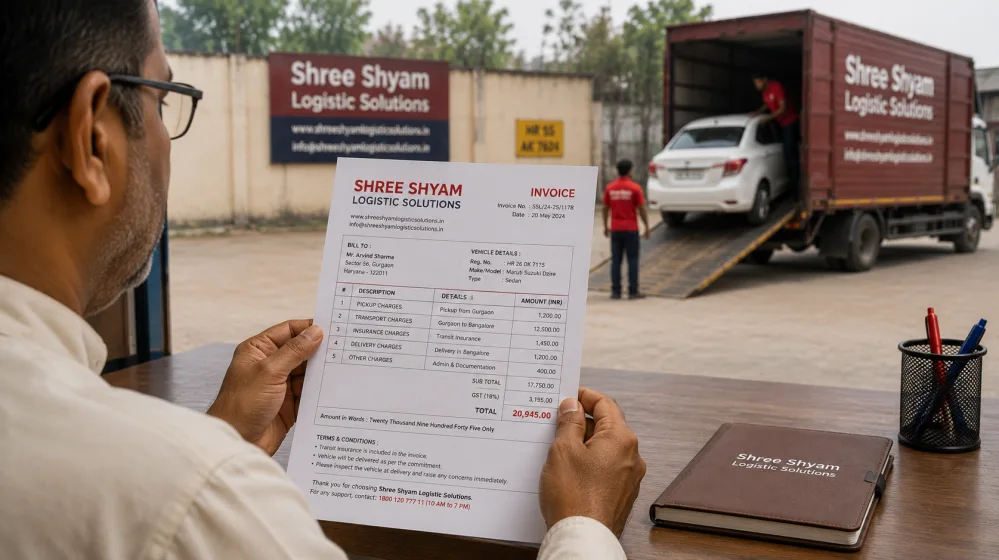
The lowest headline number on a quote is not always the cheapest option once you account for everything. A genuinely all-inclusive quote bundles loading, unloading, door-to-door pickup and delivery, tolls, permits, GST, and basic insurance documentation into one figure. A stripped-down quote may show a low base price but add charges for doorstep collection, delivery beyond a certain radius, fuel surcharge, loading crew, insurance, or even basic documentation. By the time you add those lines back, the total can exceed a quote that looked higher at first glance.
When you receive estimates from multiple transporters, put them side by side and check each line item explicitly. Ask whether GST is included or extra. Ask whether the door-to-door price covers both ends or only origin pickup. Ask whether tolls and state permits are part of the quote or billed separately at actuals. Ask whether loading and unloading charges are included. A transparent operator will answer these questions clearly and will not change the number at delivery. If a provider cannot break down their quote into clear components, treat that as a signal to look elsewhere.
At Shree Shyam Logistic Solutions, we present a single all-inclusive figure that covers pickup, transport, delivery, securing, documentation, and applicable taxes. We do not add surprise charges at the destination. That approach makes comparison straightforward — what we quote is what you pay.
- Is GST included in the quoted figure or added separately?
- Does the door-to-door rate cover both pickup and delivery ends?
- Are tolls, permits, and fuel surcharges bundled or billed at actuals?
- Is loading and unloading included or charged extra?
- What transit insurance coverage is included, if any?
- Will the final invoice match the quote, or are revisions possible?
Frequently asked questions
Why do two quotes for the same route sometimes differ significantly?
Quotes vary because of carrier type, shared versus dedicated service, included or excluded charges, insurance coverage, and pickup accessibility. A low quote may exclude GST, tolls, doorstep delivery, or loading charges that another provider bundles in. Always compare the total cost after all add-ons, not just the headline number.
Does vehicle size really affect the transport cost that much?
Yes. A large SUV or pickup truck takes more deck space and may block an adjacent slot, reducing the number of vehicles the carrier can load on that trip. Heavier vehicles also increase fuel and tyre costs. The difference between moving a compact hatchback and a full-size SUV on the same route is meaningful.
Is transit insurance worth the extra cost for a standard car?
For most owners, yes. The insurance premium is a small fraction of the vehicle value, while the financial exposure of an uninsured incident — even a minor one — can be substantial. It covers damage or loss during loading, transit, and unloading, giving you a clear claim path if anything goes wrong during the journey.
How can I reduce my car transport cost without compromising safety?
Book in advance rather than at the last minute, choose a shared carrier over a dedicated one if your timeline is flexible, avoid peak-season dates where possible, and ensure your pickup point is easily accessible to a full-size carrier. These choices lower the operational cost without affecting how securely the vehicle is handled in transit.
Talk to a vehicle transport expert
Every route and every vehicle is slightly different. If you would like this applied to your specific case — a particular car, a particular route, a particular deadline — call us on +91 99907 81652 or send us an enquiry. You will get a straight answer and a transparent quote.