Fifteen minutes of preparation before the carrier arrives prevents most delivery-day disputes. Work through this checklist the evening before pickup.
Key Takeaways
- Keep roughly a quarter tank of fuel to reduce weight and meet safety norms.
- Remove all personal belongings because transit insurance covers the vehicle only, not contents.
- Wash and photograph every panel yourself so pre-existing marks are documented independently.
- Disable aftermarket alarms and deactivate your FASTag before the carrier arrives for pickup.
- Inspect the vehicle carefully at delivery and note any concerns before signing the receipt.
Why preparation matters more than you think
Most delivery-day disputes trace back to something that should have been handled the evening before pickup. A mark that nobody noticed under road dust, a toll tag that collected charges across three states, a battery drained flat by a forgotten aftermarket alarm — each of these is avoidable with fifteen minutes of preparation. The carrier crew performs a condition report, but your own independent record strengthens your position and makes the whole process faster for everyone involved.
Preparation also protects the transporter. Undeclared fluid leaks can damage vehicles parked on lower decks. A body kit that was never mentioned may not clear the loading ramp at the normal angle. Non-start conditions require winching gear that needs to be booked in advance. The more transparent you are about your car before pickup day, the smoother the loading goes and the fewer surprises appear at delivery.
This guide walks through every step in a logical order. Work through it the evening before your scheduled pickup, and you will hand the vehicle over confidently knowing that both you and the transport team have a shared, documented starting point.
Clean the car and photograph it yourself
Washing the car is not about aesthetics — it is about making every existing scratch, stone chip, dent and kerbed alloy visible. Road dust, bird droppings and tree sap hide surface marks that only appear once the car is cleaned at the destination. If those marks were already there but not visible during the pickup report, you have an unresolvable disagreement. A clean car removes that ambiguity entirely and protects both you and the transporter.
After washing, photograph every panel, the roof, both bumpers, all four alloys, the windscreen and any existing damage close up. Include the odometer and fuel gauge in one shot. Use your phone camera with the timestamp feature enabled, or take a screenshot of the photo metadata afterward. This becomes your personal record alongside the condition report the carrier crew prepares. It costs nothing and takes about five minutes.
Pay particular attention to areas that pick up marks easily — lower door edges, rear bumper corners, the front lip and wing mirror housings. These are exactly the spots that contact ramp edges or strapping hardware if something goes wrong, and they are the spots most often disputed after delivery.
Need a quote while you read?
Share your route and vehicle — we reply with an all-inclusive price.
Empty the cabin and boot completely
Transit insurance covers the vehicle structure, not its contents. Sunglasses left on the dashboard, a laptop bag in the boot, gym kit behind the seats — none of it is covered if it disappears or gets damaged during transit. Remove everything, including items in the glovebox, door pockets, seatback holders and under-seat storage. Check the boot thoroughly, including the spare wheel well where people often leave tools or phone chargers.
Beyond the insurance issue, loose items move around over thousands of kilometres of highway driving. A heavy water bottle or toolkit rattling in the boot can scratch interior trim or crack a tail-light lens from the inside. Lighter items like paper cups or receipts get sucked into ventilation ducts. The cleaner you leave the interior, the better condition it arrives in.
- Glovebox — remove documents, cash, pens, sunglasses and USB drives.
- Door pockets — clear bottles, umbrellas and parking cards.
- Boot and spare wheel well — take out bags, tools and loose chargers.
- Seatback pockets and under-seat area — check for phones, wallets and keys.
- Dashboard and centre console — remove FASTag holder contents and coin trays.
Reduce fuel and handle toll tags
Keep roughly a quarter tank of fuel. This gives enough for the short drives during loading, unloading and your trip home from the delivery point, without carrying unnecessary weight across the full journey. A full tank adds anywhere from twenty to fifty kilograms depending on the car, increases the centre of gravity and serves no purpose since the vehicle is not being driven the distance. It also represents a larger volume of flammable liquid inside an enclosed carrier, which is why most transporters set a quarter-tank guideline.
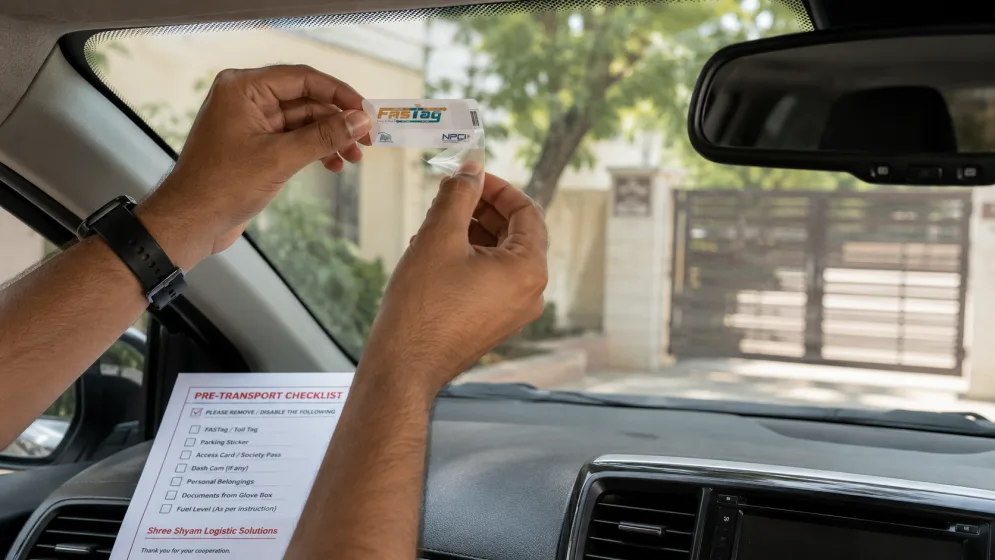
For your FASTag or any electronic toll collection device, you have two choices: deactivate the tag through your bank or wallet app, or physically remove it from the windscreen. The carrier passes through multiple toll plazas and while most use commercial tags, there is always a chance a reader picks up a passenger-vehicle tag in close proximity. Removing it is the safer option. Similarly, remove parking RFID cards for your apartment or office — these have no use during transit and are easily misplaced.
Disable alarms and fold external parts
Aftermarket security alarms — particularly older ones with motion sensors or tilt detectors — are triggered easily during loading, carrier movement and unloading. Once triggered, they drain the battery over the course of a multi-day journey and the vehicle arrives with a flat battery and no way to drive it off the ramp. If your alarm has a valet or transport mode, enable that. If not, disconnect it or ask your car electrician to isolate it temporarily before pickup day.
Fold your wing mirrors into the body. If they are manual-fold mirrors, tuck them in. If power-fold, use the button and leave them stored. Retract or unscrew any antenna mast. Remove roof-mounted accessories like a detachable roof rack, cargo box or bicycle carrier. These protrude beyond the vehicle silhouette and risk contact with the carrier structure, other vehicles or ramp edges during loading and unloading. The carrier crew should not be responsible for removing accessories they did not fit.
If your car has a retractable spoiler, manually lower it or switch off the automatic deployment. Wide aftermarket wheels or lowered suspension should be declared when booking so the transporter assigns the correct deck and ramp angle.
Declare modifications and special conditions upfront
A lowered ride height, a wide body kit, stretched tyres, an air suspension setup, a non-start condition or a soft-top roof all change how your car is loaded. None of these are problems for an experienced carrier crew, but they do require advance planning. A body kit that sits lower than factory spec may scrape on a standard-angle ramp. Wide wheels may not fit into standard wheel cradles. A non-running car needs a winch and a differently angled ramp approach. If the crew arrives unprepared, you face a rescheduled pickup.
Tell the transporter everything relevant at the quoting stage — not just so the right equipment shows up, but because modifications sometimes affect which deck the car is placed on or whether it can share space with other vehicles. Low cars typically go on the lower deck where the ramp angle is shallowest. Vehicles with wide bodies need adjacent space left empty. This information lets the logistics team plan the load correctly from the start.
Check tyres, battery and fluid leaks
The vehicle needs to drive on and off the carrier ramp under its own power at both ends of the journey — unless you have pre-arranged a non-start pickup. Check that all four tyres are inflated to a safe pressure. They do not need to be at the exact recommended figure since the car is not being driven on the highway, but a visibly flat tyre makes ramp driving awkward and risks rim damage on the hydraulic ramp surface.
Battery health matters for the same reason. If your car has been sitting for weeks, start it the day before pickup and let it idle for ten to fifteen minutes to bring the charge up. A healthy battery also ensures the car can be moved off the ramp quickly at delivery without needing a jump start, which delays handover for everyone on a multi-car carrier.
Finally, check under the car for oil, coolant or power-steering fluid drips. In a multi-level carrier, your vehicle may be parked above someone else's car. A steady leak that goes undeclared can damage another vehicle's paint or roof lining. If you know about a leak, report it when booking — the crew will position the car on the lowest deck or place a drip tray where needed.
- Inflate all tyres to a safe, driveable pressure the day before pickup.
- Start the engine and idle for ten minutes if the car has been parked for weeks.
- Inspect the ground under the car for oil, coolant or fluid spots.
- Report any known leak at the booking stage so deck placement is adjusted.
Keys, documents and what to hand over
Hand over one working key to the carrier crew. Retain your spare key separately — sending both keys with the vehicle is an unnecessary risk. If your car uses a keyless entry system with a proximity fob, make sure the fob you hand over actually starts the engine and does not just open the doors. Test it the day before.
Keep your registration certificate (RC), insurance copy and a personal ID accessible during pickup because the crew will verify details against the booking and note the RC number on the condition report. You do not typically need to leave original documents with the vehicle unless the transporter specifically requests a copy for interstate permit compliance — in that case, a photocopy or digital copy is usually sufficient. Ask in advance what is needed so you are not scrambling at the doorstep.
What to check at delivery before signing
When the carrier arrives at your destination, do not sign the delivery receipt until you have walked the vehicle against the original condition report. Check the same panels you photographed at pickup — both bumpers, door edges, the roof, wing mirrors and alloys. Look at the windscreen for new chips. Open the doors and boot, check the interior has not been disturbed, and confirm the odometer reading has not jumped significantly beyond what a short ramp drive would produce.
Check under the vehicle briefly for any new scrapes on the underbody, particularly the front lip and exhaust. Verify that the key works, the engine starts and the car drives normally off the ramp. If you spot something that was not on the original report, photograph it immediately and note it on the delivery sheet before you sign. Once you sign without annotation, any subsequent claim becomes significantly harder to pursue.
Finally, confirm handover of the key, any documents that travelled with the vehicle, and accessories such as the tool kit or spare wheel cover if they were noted at pickup. A careful five-minute delivery inspection saves weeks of back-and-forth later.
- Walk every panel against the pickup condition report before signing.
- Check the windscreen, alloys, mirrors and underbody for new marks.
- Start the engine and confirm the car drives normally off the ramp.
- Photograph any new damage immediately and annotate the delivery sheet.
- Verify key handover, odometer reading and accessory list.
Frequently asked questions
How much fuel should I leave in the car before transport?
Keep roughly a quarter tank. This gives enough fuel for loading, unloading and a short drive at the destination without adding unnecessary weight or increasing the volume of flammable liquid inside the enclosed carrier. A full tank serves no purpose because the car is not driven the distance — it travels on the carrier deck.
Are my personal belongings covered by transit insurance during car transport?
No. Transit insurance covers the vehicle structure and its factory-fitted components. Personal items such as electronics, clothing, documents, cash or accessories left inside the cabin or boot are not covered. Remove everything before pickup and transport personal belongings separately to avoid loss or interior damage from items shifting in transit.
What should I do if my car has modifications or does not start?
Declare any modifications — lowered suspension, wide body kits, aftermarket wheels — and non-start conditions when you request your quote. These require specific equipment like a winch or a low-angle ramp, and may change which carrier deck is assigned. Telling the transporter in advance ensures the right gear arrives on pickup day and avoids rescheduling.
Can I refuse to sign if I notice new damage at delivery?
You should never sign without noting the issue. If you spot damage that was not on the original pickup condition report, photograph it immediately and write a clear description on the delivery sheet before signing. This documented annotation is your evidence for any subsequent claim. Once you sign a clean receipt, proving the damage occurred in transit becomes very difficult.
Talk to a vehicle transport expert
Every route and every vehicle is slightly different. If you would like this applied to your specific case — a particular car, a particular route, a particular deadline — call us on +91 99907 81652 or send us an enquiry. You will get a straight answer and a transparent quote.