
For a dealership, transport failure is not one unhappy customer — it is stock sitting idle. These are the operational standards worth writing into your contract.
Key Takeaways
- Reserve committed carrier capacity monthly rather than relying on ad-hoc best-effort dispatch slots.
- Insist on unit-wise photographed condition reports at both loading and delivery for every vehicle.
- Consolidated GST-compliant invoicing simplifies reconciliation and keeps your finance team satisfied.
- A single named account coordinator eliminates repeated explanations and speeds up issue resolution.
- Agree on damage escalation timelines and receiving-bay schedules before the first dispatch rolls out.
Why dealers need a logistics checklist
For an individual owner, a delayed or damaged car is a personal inconvenience. For a dealership, it is lost revenue. Stock that arrives late sits as idle capital. Stock that arrives scratched cannot hit the showroom floor until paint correction is complete, pushing back a delivery date you already committed to a buyer. Multiply that across dozens of units a month and the operational drag becomes significant. A structured logistics checklist protects your margins and keeps your sales timeline intact.
Most transport relationships start well and decay over time because expectations were never written down. Your dispatch manager knows what good looks like, but the transporter's operations team rotates drivers and crew without that institutional memory. A documented checklist — ideally an annexure to your transport contract — means any crew member on any trip knows the standard they must hit, regardless of who briefed them.
This article walks through the items that belong on that checklist, from planning stage through delivery and invoicing. It is written for dealership logistics heads, fleet managers at leasing companies, and OEM dispatch coordinators moving vehicles in bulk across Indian routes, including corridors out of Delhi NCR and Gurgaon where many distribution hubs sit.
Planning stock transfers and capacity booking
Bulk vehicle movement is not a taxi service. Carrier space needs to be reserved ahead of time, especially on high-demand corridors during festive and year-end periods. If your transporter is offering best-effort loading with no committed slots, your vehicles will queue behind whoever called first that week. For predictable volume — say a regular fortnightly movement of eight to twelve cars — a contracted slot guarantees your units leave on the scheduled date without negotiation each time.
Start by mapping your monthly movement patterns: origin yards, destination showrooms, average unit count per dispatch, and any peak periods tied to model launches or quarter-end pushes. Share this data with your transporter upfront. A good logistics partner will plan carrier rotation around your volumes and flag capacity constraints weeks in advance rather than the morning of loading. If your volumes fluctuate heavily, agree on a base commitment plus a mechanism for ad-hoc overflow so neither side is caught off guard.
Need a quote while you read?
Share your route and vehicle — we reply with an all-inclusive price.
Zero-kilometre handling for new inventory
New vehicles coming off a plant yard or port compound carry zero delivery kilometres on the odometer. The customer buying that car expects factory-fresh condition, and any mark picked up in transit becomes your problem to fix before handover. This makes handling standards for new stock materially different from used-car movements where minor cosmetic history already exists.
Demand that your transporter uses enclosed multi-car carriers for new stock, with hydraulic ramp loading so no undercarriage scraping occurs at approach angles. Wheel-strap securing at the tyre and rim — never hooks on painted panels or body lips — should be the only method used. Between decks, clearance must be enough that no roof contacts the deck above. Low-clearance sport variants need the lowest deck position assigned by default, and the loading crew should confirm ground clearance before driving any unit up a ramp.
Pre-delivery inspection stickers, protective film on bumpers and door edges, and temporary paper mats inside the cabin should stay in place throughout transit. If your OEM ships with these protections fitted, specify in the contract that they must not be removed at any stage by the transport crew.
Unit-wise condition documentation at loading
A loading sheet that simply lists chassis numbers and says "OK condition" protects nobody. Insist on a per-unit photographed condition report taken at the point of loading, covering every painted panel, all four wheels, both bumpers, windscreen, roof, door shuts, interior seats and dashboard. Each photograph should be time-stamped and tagged to the chassis or registration number so there is no ambiguity about which vehicle it belongs to.
The same report must be repeated at delivery before any vehicle leaves the carrier. A panel-by-panel walkthrough with your receiving staff — not just a driver handing over keys — is the only way to catch transit damage in real time. Without that mirror process at both ends, a dispute three days after delivery becomes word against word. Your contract should state that any damage not recorded in the delivery report is the responsibility of whoever last held the vehicle.
- Photograph every panel, bumper, wheel and roof per vehicle at loading.
- Time-stamp and tag each image to chassis or registration number.
- Repeat the same photographic inspection at delivery before sign-off.
- Note fuel level, odometer reading and presence of tools and spare wheel.
- Both parties sign the report — no verbal-only acknowledgements.
Consolidated invoicing and GST compliance
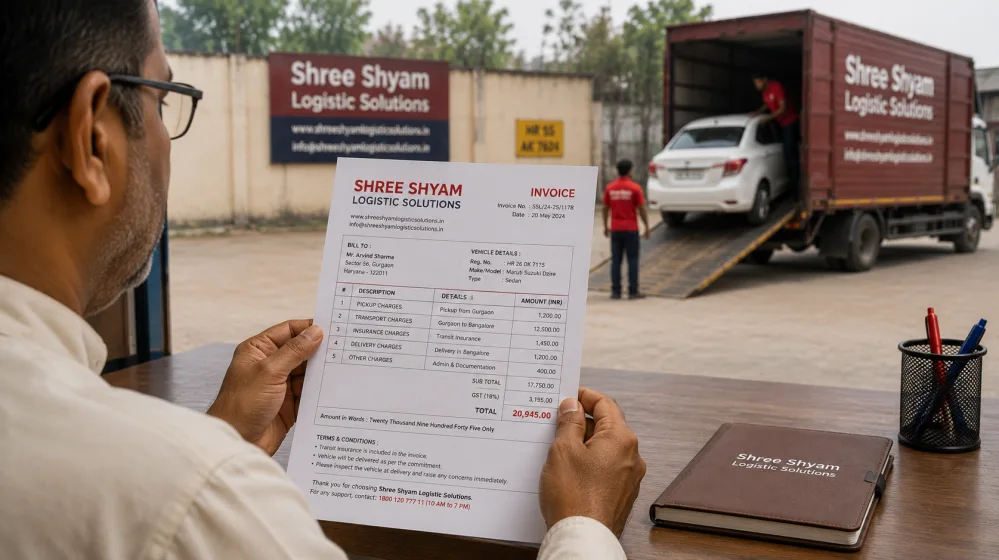
Chasing individual trip invoices across dozens of dispatches each month is a drain on your accounts team. A consolidated monthly invoice — broken down by route, unit count, and applicable GST — is the standard you should require. The invoice format should match your ERP import template so reconciliation does not become a manual data-entry exercise every month-end.
Confirm that your transporter issues invoices under the correct SAC code for goods transport services and that the GSTIN on each invoice matches their registered entity. For inter-state movements, IGST applies; for intra-state, CGST and SGST split equally. Your transporter should handle e-way bill generation for each consignment where the threshold applies, and share the e-way bill number with your dispatch team before the carrier leaves the yard. Missing or expired e-way bills create checkpoint delays that directly impact your delivery timelines.
If your volumes justify it, negotiate route-wise contracted rates rather than per-trip quotations. This gives your finance team a predictable cost line for budgeting and removes the back-and-forth of approving each dispatch individually. The rate card should be reviewed quarterly and adjusted for fuel-index changes or significant route additions.
Committed timelines and service-level agreements
A verbal promise of delivery within a vague window is not a service-level agreement. Your contract should specify corridor-wise transit days — for example, a Gurgaon to Bangalore movement might carry a defined window based on distance and typical highway conditions. The SLA should also define what constitutes a delay, what notice period the transporter must give if a delay is unavoidable, and what remedy applies if the agreed window is missed without prior communication.
Be realistic about what road logistics in India can guarantee. Weather disruptions, highway repair closures, festival traffic, and state-border formalities are genuine variables. A good SLA acknowledges these with a force-majeure clause but still holds the transporter accountable for delays within their control — late dispatch, crew unavailability, breakdown due to poor maintenance, or routing errors. The remedy might be a credit note, priority on the next dispatch, or a defined escalation path rather than a punitive penalty that incentivises the transporter to hide problems.
Single point of contact and account management
Dealer logistics involves repeat movements, standing instructions, and preferences that build up over months. If your dispatch manager has to re-explain loading-bay access times, model-specific clearance notes, or invoicing formats to a different person on every call, efficiency collapses. Demand a named account coordinator — one person who owns your relationship, knows your yard layout, understands your peak periods, and can mobilise internal resources without your team chasing multiple departments.
That coordinator should provide a weekly or fortnightly status summary: units in transit, expected delivery dates, any open damage claims, and upcoming capacity bookings. This summary feeds directly into your stock-planning and sales-commitment processes. If the coordinator is unavailable, a designated backup who has read access to your account history should step in — not a generic helpline that starts from scratch every time.
Batching versus dedicated carrier decisions
Shared multi-car carriers are the economical default for most dealer movements. Your vehicles share deck space with other consignments heading in the same direction, which keeps per-unit cost lower but means departure timing is partly dependent on the carrier filling up. For routine stock replenishment where a day or two of flexibility exists, this is the sensible choice and the one most dealers use for the majority of their dispatches.
Dedicated carriers make sense in specific situations: a model-launch batch that must arrive by an event date, high-value luxury units where you want no co-loading risk, or an urgent stock transfer to clear a sales commitment. The cost is higher because you are paying for the full carrier regardless of how many slots you fill. Weigh the per-unit premium against the commercial consequence of a late or damaged arrival. For most regular movements, batching on scheduled shared carriers with a contracted departure window gives the best balance of cost and reliability.
- Shared carriers suit routine replenishment with a day or two of schedule flexibility.
- Dedicated carriers suit launches, luxury stock, or hard delivery deadlines.
- Hybrid approach: batch most stock, reserve dedicated capacity for time-critical units.
- Agree on a maximum wait time before a shared carrier departs regardless of fill level.
Receiving-bay scheduling and damage escalation
Carriers arriving unannounced disrupt your showroom operations. The unloading area is blocked, sales staff are pulled off the floor, and if the bay is already occupied by a customer delivery or a service-department vehicle, the carrier idles on the road. Your checklist should mandate that the transporter confirms a delivery window at least a day in advance, and that your yard or receiving team acknowledges the slot. This keeps your operations predictable and gives your team time to clear space and assign someone to the walkthrough inspection.
Damage escalation deserves its own written process. Define what qualifies as reportable damage — typically anything beyond light dust or rail-rash that wipes off. Set a timeline for the transporter to acknowledge a claim once reported, a deadline for their internal investigation, and a resolution window within which either a repair cost is agreed or insurance is triggered. Without these timelines, claims drift into weeks of follow-up emails with no closure, and your PDI team loses faith that reporting issues is worth the effort.
At Shree Shyam Logistic Solutions, we work with dealer partners across Delhi NCR to define these processes upfront so that the first disputed unit does not become a relationship problem. A clear escalation matrix — who to contact, what evidence to attach, and what response time to expect — keeps both sides professional when things go wrong.
Frequently asked questions
How far in advance should a dealership book carrier capacity for bulk movements?
For regular contracted volumes, share your monthly forecast at least two weeks ahead so the transporter can plan carrier rotation. For ad-hoc or overflow dispatches, three to five working days of notice is reasonable on most corridors. During festive or year-end peaks, extend the lead time further as carrier availability tightens across the industry.
What documentation should travel with each vehicle dispatch?
Each dispatch should carry a unit-wise loading sheet with chassis numbers, a photographed condition report per vehicle, a valid e-way bill where the threshold applies, a consolidated consignment note referencing your contract, and the driver and carrier identification details. Your receiving team needs a copy of the loading report to compare against at delivery.
Who is responsible if a vehicle is damaged during transit?
Responsibility sits with the transporter from the moment the loading report is signed to the moment the delivery report is signed at destination. Your contract should state this explicitly. Transit insurance provides a financial backstop, but the transporter should first attempt resolution — repair or compensation — within a defined timeline before an insurance claim becomes necessary.
Can shared carriers maintain the same quality standards as dedicated ones?
Yes, provided the transporter uses enclosed carriers with proper securing for every vehicle regardless of ownership. The quality difference is not about sharing deck space — it is about handling discipline, strap method, and crew training. Shared carriers are standard for dealer stock. The trade-off is timing flexibility, not care level.
Talk to a vehicle transport expert
Every route and every vehicle is slightly different. If you would like this applied to your specific case — a particular car, a particular route, a particular deadline — call us on +91 99907 81652 or send us an enquiry. You will get a straight answer and a transparent quote.